Human beliefs, emotions, stories, and traditions have traveled through the ages in the form of “ancient symbols.” From very early on, men and women inscribed symbols on stones, temples, pots, tombs, jewelry and sacred objects.
They facilitated people to represent concepts of life, death, love, protection, wisdom, nature, gods and the afterlife.
Some of the early symbols had religious connotations, while others were associated with strength, courage, fertility, victory, balance or familial relationships.
Many of these symbols continue to be used today in tattoos, jewelry, artwork, books, movies, fashion and spiritual practice. What is special about them, is that they can tell a story with a simple shape.
An idea can be expressed in a circle, an eye, a tree, a serpent, or even a flower, as words can take numerous pages to explain.
What Are Ancient Symbols?
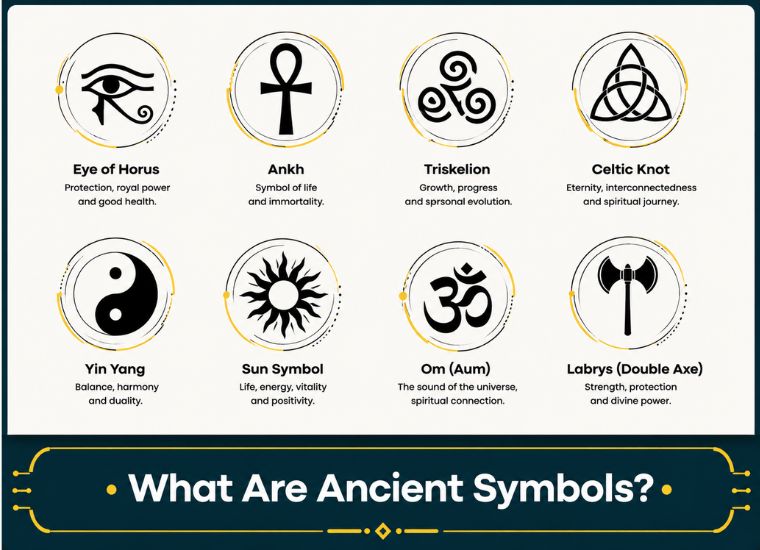
Ancient symbols are marks, shapes, images or sacred marks made by early civilizations to express beliefs, emotions, natural forces, gods, or cultural traditions.
They were found in ancient Egypt, Greece, Rome, Mesopotamia, China, India, Celtic countries, and Norse countries. They were put on manuscripts, personal objects, shields, coins, pottery, and tombs and temples.
Protection, strength, wisdom, eternal life, fertility, rebirth and spiritual power might all be represented by one symbol. Many were also adopted for ritual or cultural purposes.
Today, ancient symbols bridge the gap between the present and the past, between mythology, folklore and old traditions.
Why Ancient Symbols Still Fascinate People
Ancient symbols are historic, enigmatic, beautiful and emotional.
The eye might indicate protection, the tree growth, and the serpent transformation. Their meanings can be different in various cultures too.
The context of the symbol’s history and culture is significant when learning about a symbol. These signs continue to be popular as they allow a person to communicate a strong message with limited words.
Understanding of the meanings of ancient symbols.Interpretation of ancient symbols.
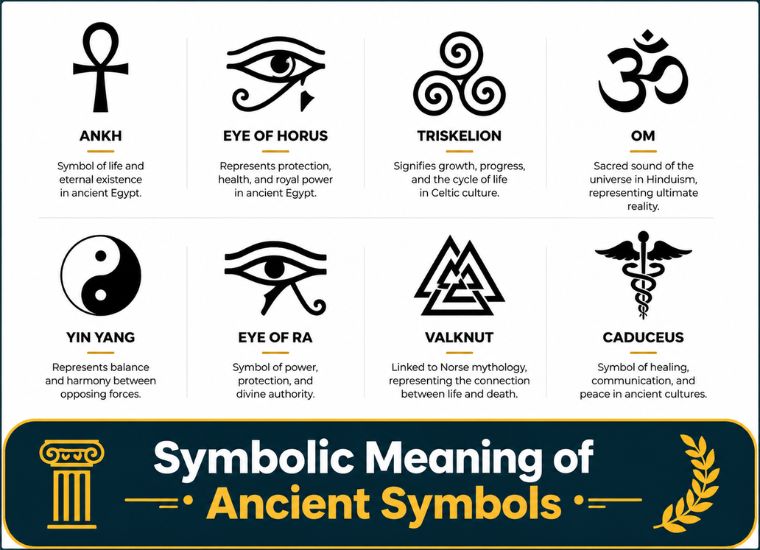
Symbolic Meaning of Ancient Symbols
Spiritual Meaning
Many ancient symbols were related to spiritual beliefs, protection, healing, prayer, sacred places and gods.
In ancient Egypt, the Ankh symbolized life, and in Hindu and Buddhist beliefs, the lotus symbolized purity and spiritual development.
Psychological Meaning
Symbols can also be an expression of human feelings or of life events.
The phoenix can symbolize a person’s recovery from adversity, and the labyrinth can be a metaphor for a challenging path toward enlightenment.
Cultural Meaning
Symbols played an important role in cultural life. Courage was shown on Warriors’ signs, families wore protective signs and rulers wore signs of authority.
These signs helped to transmit stories and traditions from generation to generation.
90+ Most Powerful Ancient Symbols
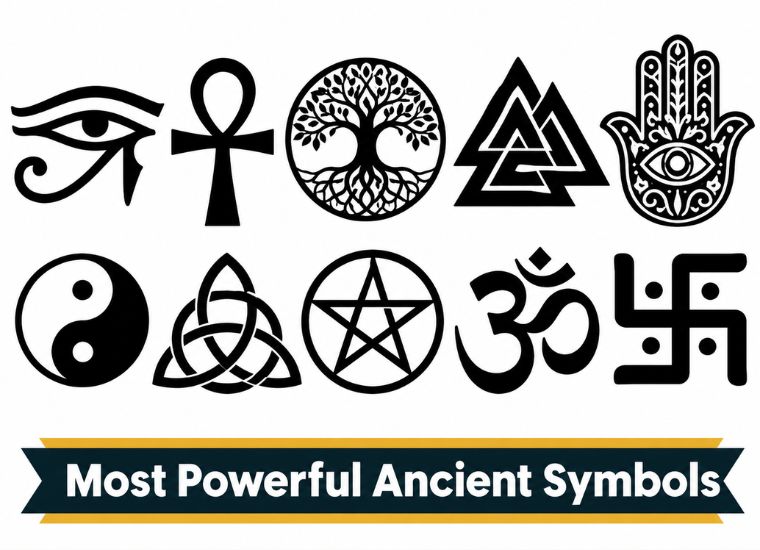
Ankh
- Visual Description: A cross-shaped sign with a loop at the top.
- Meaning: Life, immortality, protection, and spiritual existence.
- Where It Appears: Egyptian temples, tombs, jewelry, and artwork.
One of the most recognizable Egyptian symbols is the Ankh, which was associated with life.
Eye of Horus
- Visual Description: A stylized eye with curved markings.
- Meaning: Protection, healing, restoration, and awareness.
- Where It Appears: Egyptian amulets, temples, jewelry, and artwork.
It came to be a well-known protective symbol associated with Horus.
Eye of Ra
- Visual Description: A powerful eye connected with the sun.
- Meaning: Protection, authority, strength, and solar energy.
- Where It Appears: Egyptian art, temples, carvings, and royal objects.
Scarab Beetle
- Visual Description: A powerful eye connected with the sun.
- Translation: Protection, strength, authority, and solar energy.
- Where It’s Found: Egyptian art, temples, carvings, and royal objects.
Djed Pillar
- Visual Description: A tall pillar with horizontal lines near the top.
- Meaning: Stability, strength, endurance, and balance.
- Where It Appears: Egyptian temples, tombs, and amulets.
Uraeus
- Visual Description: An upright cobra shown on the forehead.
- Meaning: Royal power, protection, and divine authority.
- Where It Appears: Egyptian crowns, statues, temples, and royal artwork.
Shen Ring
- Visual Description: A circle that completes a circle.
- Translation: Eternity, protection and timelessness.
- Occurrence: Egyptian art (carvings, jeweler, amulets).
Ouroboros
- Visual Description: A serpent eating its own tail.
- Meaning: Eternity, rebirth, cycles, and transformation.
- Where It Appears: Ancient art, philosophy, alchemy, and modern designs.
Celtic Knot
- Visual Description: Interwoven lines forming endless loops.
- Meaning: Eternity, connection, loyalty, and unity.
- Where It Appears: Celtic artwork, manuscripts, jewelry, and tattoos.
Triskelion
- Movement Description: Three curved arms coming from a central base.
- Def: Movement, growth, cycles, and balance.
- Where It Can Be Found: Celtic art, stone carvings and jewelry.
Tree of Life
- Visual Description: A tree with deep roots and spreading branches.
- Meaning: Growth, wisdom, family, balance, and connection.
- Where It Appears: Norse mythology, Celtic culture, religious art, and spiritual designs.
Lotus Flower
- Visual Description: A flower growing out of the water.
- Translation: Purity, rebirth, peace, spiritual growth.
- Where It’s Found: In Hinduism and Buddhist art, in temples, while meditating, and in jewelry.
Om
- Visual Description: A sacred curved character.
- Meaning: Universal consciousness, sacred sound, peace, and spirituality.
- Where It Appears: Hindu temples, manuscripts, meditation spaces, and spiritual artwork.
Yin Yang
- Visual Description: Half of a circle curved into two parts.
- Meaning: Balance, harmony, opposite forces, and unity.
- It is found in: Chinese philosophy, art, jewelry, modern designs.
Chinese Dragon
- Visual Description: A long mythical creature with a strong body.
- Significance: Strength, prosperity, wisdom and protection.
- Where It Appears: Chinese art, temples, festivals, and architecture.
Phoenix
- Visual Description: A mythical bird rising from flames.
- Meaning: The meaning of the word is Rebirth, renewal, hope and transformation.
- Where it comes from: Mythology, art, literature, jewelry, and tattoos.
Greek Key
- Repeated Geometric Line: A line used for a pattern, repeated geometric shapes.
- Meanings: The meaning is Eternity, Continuity, Order and Unity.
- Where It is found: Greek architecture, pottery, mosaics, and jewelry.
Laurel Wreath
- Visual Description: Laurel crown, circular in shape.
- Meaning: Defeat, dishonor, failure and disgrace.
- Where It Appears: Greek and Roman art, coins, statues, and ceremonies.
Labyrinth
- Visual Description: A long winding path towards a center.
- Meanings: Journey, struggle, patience, and growth.
- Where It Appears: Greek mythology, ancient art, architecture and modern designs.
Caduceus
- Elements of a pictorial image: Two snakes forming a ring around a staff with a wing.
- Meaning: Communication, trade, movement and balance.
- It’s found in: Greek mythology, ancient art and coins.
Rod of Asclepius
- Visual Description: One serpent wrapped around a staff.
- Purpose: To heal, cure, medicine, health.
- Where it appeared: Greek mythology, temples and medicine.
Cornucopia
- Visual Description: Two serpents around a winged staff.
- Meaning: Communication, trade, movement, and balance.
- Where It Appears: Greek mythology, ancient art, and coins.
Medusa
- Visual Description: A woman with snakes in her hair.
- Meaning: The meaning of the word is “Protection, danger, fear, transformation.
- Where It Appears: in Greek mythology, in pottery, sculptures and contemporary artworks.
Mjölnir
- Visual Description: A short-handled hammer.
- Meaning: The definition of meaning is strength, protection, courage and power.
- In which it can be found: In the realm of Norse mythology, Viking artefacts, jewellery and tattoos.
Valknut
- Visual Description: A set of three intersecting triangles.
- Meaning: Death, courage, warriors, divine connections.
- It is found in: Norse art and objects.
Vegvísir
- Visual description: Circular design with a number of directional arms.
- Guidance: Direction; navigation.
- Where it’s found: Icelandic manuscripts and modern tattoos.
Yggdrasil
- Visual Description: A huge mythical tree connecting different realms.
- Meanings: Life, wisdom, connection, cosmic order.
- Where It appears: Norse mythology and contemporary artwork.
Lamassu
- Visual Description: A winged creature with a human head and animal body.
- Meaning: Protection, authority, and royal power.
- Where It Appears: Assyrian palaces, gates, and sculptures.
Winged Sun Disk
- Visual Description: A sun disk with wings.
- Meaning: Divine power, protection, kingship, and heavenly order.
- Where It Appears: Egyptian and Near Eastern artwork.
Crescent Moon
- Visual Description: A curved moon shape.
- Meaning: Cycles, time, renewal, and night.
- Where It Appears: Ancient coins, religious artwork, jewelry, and mythology.
Spiral
- Visual Description: A curved line winding around a center.
- Meaning: Growth, movement, life cycles, and change.
- Where It Appears: Prehistoric carvings, Celtic art, and pottery.
Hamsa
- Visual Description: Hand with central eye, open hand.
- Meaning: Safeguarding, blessing, security and prosperity.
- It’s found in: Middle Eastern and North African traditions, jewelry, and art.
Evil Eye
- Visual Description: An eye-shaped protective motif.
- Meaning: Protection from envy and harmful intentions.
- Where It Appears: Mediterranean, Middle Eastern, and North African traditions.
Flower of Life
- Visual Description: Overlapping circles forming a flower-like pattern.
- Meaning: Creation, harmony, unity, and sacred geometry.
- Where It Appears: Sacred art, modern spiritual designs, and jewelry.
Pentagram
- Visual Description: A five-pointed star created by connecting the points.
- Meanings: The subject of the painting is about protection, balance, elements and spiritual ideas.
- It is found in: Greek thought, later in European traditions and modern symbolism.
Mandala
- Visual Description: A circular design with balanced patterns.
- Meaning: Harmony, unity, meditation, and cosmic order.
- Where It Appears: Hindu and Buddhist art, temples, and meditation practices.
Dharma Wheel
- Visual Description: A wheel with several spokes.
- Meaning: Spiritual teaching, wisdom, and the path of life.
- Where It Appears: Buddhist temples, statues, and artwork.
Endless Knot
- Visual Description: Line that goes over itself in a continuous manner.
- Meanings: Eternity, wisdom, connection, interdependence.
- Where It is Found: Buddhist art, textiles and jewelry.
Trishula
- Visual Description: A spear with three heads.
- Meaning: The power, protection, creation and destruction.
- It can be found : Hindu temples, statues and sacred objects.
Sphinx
- Visual Description: A creature with a human head and lion’s body.
- Meanings: Royal power, strength, wisdom and mystery.
- It appears: In ancient Egypt, at the temple, in sculpture and in monuments.
Griffin
- Visual Description: A creature with a lion’s body and eagle’s head and wings.
- Meaning: Strength, courage, guardianship, and authority.
- Where It Appears: Greek, Persian, and Near Eastern art.
Eagle
- Physical Description: Large, strong bird with large wings.
- Translation: Freedom, strength, vision and authority.
- Where it has appeared: Greek, Roman and Near Eastern traditions.
Owl
- Visual Description: A bird with big eyes facing forwards.
- Occultation: Wisdom, knowledge, mystery and night.
- Its appearance: Greek mythology, coins and art.
Lion
- Visual Description: A strong big cat.
- Meanings: The meaning of the word is Courage, Strength, Royalty and Protection.
- In which it appears: Egyptian, Mesopotamian, Greek and Roman art.
Bull
- Common Name: A good looking, horned animal.
- Meanings: Strength, fertility, power and abundance.
- Where It Appears: Mesopotamian, Minoan, Egyptian and Greek traditions.
Serpent
- Visual Description: Long curved figure like a snake.
- Meaning of the symbols: Transformation, healing, danger, wisdom and renewal.
- It is found in Egyptian, Greek, Hindu and Mesoamerican traditions.
Sun Wheel
- Visual Description: A wheel in the shape of a circle with intersecting lines across it.
- Meaning: Sun, seasons, direction and life cycles.
- Where It Appears: European archaeological objects and subsequent cultural designs.
Fish
- Visual Description: A simple fish-shaped image.
- Meanings: Life, fertility, abundance and water.
- Where it appear? Mediterranean, Asian, and religious traditions.
Horse
- Visual Description: A running or standing horse.
- Meaning: Freedom, travel, strength, speed, and loyalty.
- Where It Appears: Greek, Roman, European, and Asian traditions.
Raven
- Descriptive Words: Broad-winged bird that is dark.
- Symbols: Wisdom, mystery, memory, death, prophecy.
- Where It Can Be Found: In stories from the Nordic, Celtic and folklore and traditional literature.
Ancient Symbols Across Different Cultures
Ancient Egypt
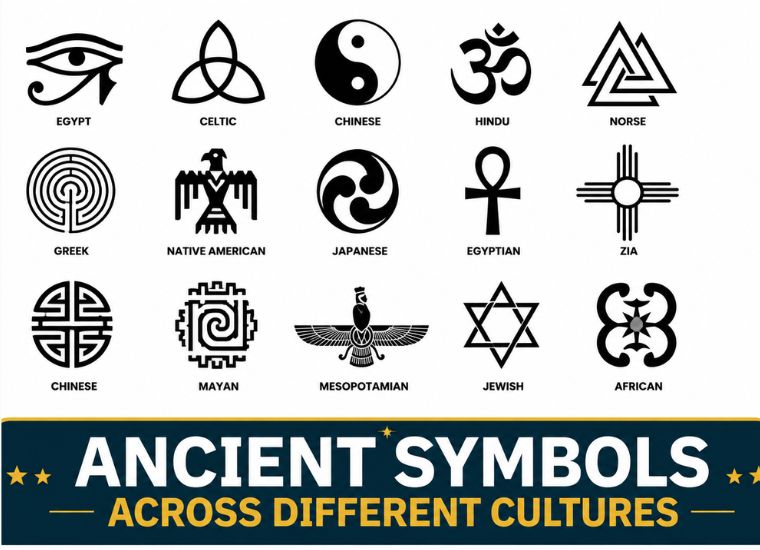
Tombs and Temples were filled in Egypt with symbols associated with gods, death, protection, kingship and the afterlife. The Ankh symbolised life, the scarab symbolised renewal, and the Eye of Horus was transformed into a protective symbol.
Ancient Greece
The Greek symbolism centered around wisdom, heroism, destiny, triumph, and mythology. The owl got associated with wisdom and the laurel wreath with honour and victory.
Ancient Rome
Military power, authority, victory, and religion were frequently represented by the use of Roman symbols. The eagle was firmly linked with military status and the laurel wreath was a symbol of success.
Celtic Culture
Symbols associated with the Celts frequently symbolized nature, cycles, connection and spirituality. Knots and spirals gained popularity for their infinite designs and organic shapes.
Norse and Viking Culture
Norse symbols were associated with gods, warriors, fate, protection and the natural world. The power of Thor was represented by Mjölnir, and the world tree was represented by Yggdrasil.
Ancient China
Chinese symbolism was frequently about harmony, balance, nature, wisdom and good fortune. Yin yin was symbol of balance and dragons were connected with strength, power and good fortune.
Hindu and Buddhist Traditions
Om, lotus flowers, mandalas, Dharma wheels, endless knots, conch shells, and vajras are all linked to spiritual practices, spiritual wisdom, harmony and awakening.
Ancient Symbols in Modern Culture
Tattoos
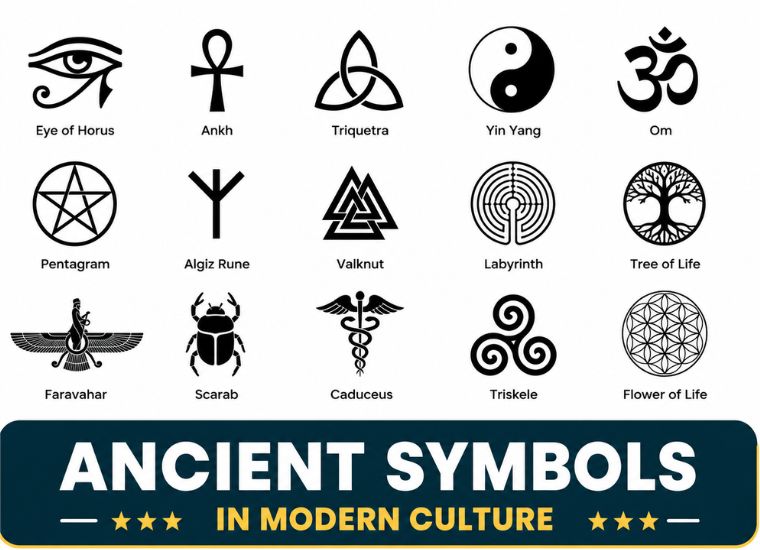
Ancient symbols are still popular tattoos as they can be used to convey personal ideas. A phoenix can be a symbol of a new beginning, and a Celtic knot can be a symbol of family or a long-lasting love.
Jewelry
Rings, necklaces, bracelets, pendants and other rings with ankhs, hamsas, Celtic knots, Mjölnir, lotus flowers and more are common.
Art and Movies
The meaning and mysteries of paintings, books, films, games and fantasy stories are enhanced by the use of ancient symbols.
Hidden knowledge or adventure is sometimes indicated by eyes, labyrinths, sacred objects, serpents and ancient scripts.
Ancient Symbols and Sacred Geometry
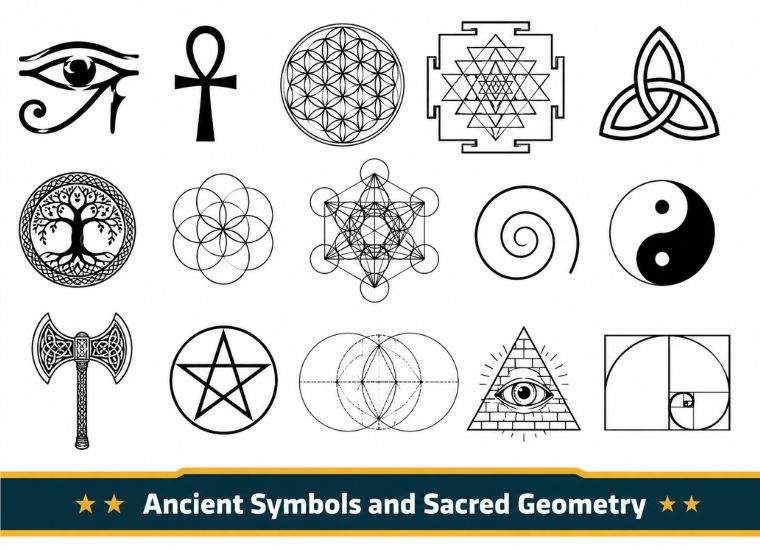
Sacred geometry involves the use of geometric forms and patterns associated with concepts of balance, harmony, and creation.
Many ancient and later works of art feature circles, triangles, spirals and overlapping shapes. Today the Flower of Life, mandala, Seed of Life and Vesica Piscis are all popular geometric designs.
They are often used in art, jewelry, and meditation areas, as well as in decorative designs, due to their balanced shapes.
Spiritual and Dream Meaning
In some instances, symbolic pictures appear during dreams, meditation or a person’s personal reflection. The eye may indicate awareness, the snake may indicate change and the tree may indicate growth.
Dream meanings vary from person to person, and are often influenced by cultural or life experience. Ancient symbol do not always carry the same meaning to every individual.
Positive and Negative Meanings
The same symbol may have a different meaning in various cultures. In one tradition, a snake might symbolize healing and in another, it could symbolize danger.
Fire can also be a symbol of rebirth and purification, but it can also be a symbol of destruction. A skull can be a symbol of death but it can also be a reminder of the importance of life.
Why Ancient Symbols Still Matter in 2026
People are still interested in love, protection, courage, wisdom, family, identity, healing, balance and purpose, and so are ancient symbols.
Today, they are found in fashion, social media, on the skin, jewelry, in films, games, books, art, and spiritual rituals. Technology has altered the ways in which people communicate but the need for meaningful images is still the same.
Conclusion
Ancient symbols are more than just old marks cut into stone. They are the visual elements of human narrative with messages of protection, identity, courage, nature, spirituality, life and death, and love.
They are symbols that have been passed down through the ages, and continue to inspire people today, thousands of years after they were created. The meanings vary according to culture, and the history and context add to their significance.
FAQs
What are ancient symbols?
Ancient symbols are graphic representations of beliefs, emotions, natural elements, deities, traditions, or significant concepts that are utilized by early cultures.
Which is the most popular ancient symbol?
Among the more well-known ancient or traditional symbols are the Ankh, Eye of Horus, Ouroboros, Celtic Knot, Yin Yang, lotus, and Tree of Life.
Which of the following is a symbol of everlasting life?
In ancient Egypt the Ankh was closely related to life and immortality. The Ouroboros and Celtic Knot may also symbolize eternity.
What is the symbol of protection?
The Eye of Horus is a potent symbol of protection in Egyptian mythology. The Uraeus and the Hamsa also have a link to protection.
What is the symbol for re-birth?
The scarab, phoenix, lotus and Ouroboros are frequently associated with renewal, rebirth or transformation.
Are all ancient symbols religious?
No. Some were religious, some were nature, some were family, some were authority, some were war, some were fertility, some were seasons and some were cultural identity.
Do the ancient symbols have continued relevance?h
Yes. But they still have applications in tattoos, jewelry, art, fashion, architecture, movies, games, spiritualism, and cultural festivity.
Is there more than one interpretation of one symbol?
Yes. The meaning of things is culturally, historically, religiously and experientially variable.